Samsung Galaxy S4 Complete Specs, Price, Available Date


After sitting through the glitziest product introduction I’ve ever been to followed by a few minutes of hands-on with the Galaxy S4, I came away impressed but not blown away.
I’ll get into details in a moment, but my overall sense of this phone is that it firmly establishes Samsung as a leading innovator — if not the leading innovator — in the smartphone space.  It’s kind of ironic that Apple won a lawsuit last year after a jury found that Samsung had copied iPhone features and designs. The Galaxy S4 — like the Galaxy S3 — could never be called a copycat.  Samsung came out with specs and features that we’ve never yet seen in a smartphone, including any phone that begins with the letter i.
True, the S4 runs Google‘s latest Jelly Bean Android software, but Samsung has done a lot to make it different from other Android phones.
Hardware specs
Like Apple, Samsung is a hardware company that innovates mainly through software. But the hardware specs are worth noting. The 5-inch full HD Super AMOLED; 1,920×1,080 screen, at 441 pixels per inch, is both bigger and higher resolution than the iPhone 5, although the HTC One has an equally high resolution — though smaller — (4.7 inch) screen.  Samsung also upped the ante with a faster processor and unlike Apple it lets users expand the phone’s storage (internal storage ranges from 16 to 64 GB) to plug in a MicroSD card for up to another 64GB. And the phone has a mega-battery. Samsung didn’t say how long the battery will last, but it does have 2,600 mili amp hours,  which is a lot more than the competition. I refer you to a handy CNET chart comparing the S4′s specs with those of the iPhone, HTC One and the Blackberry Z10 if you want more details.
Innovative software & cool photo features
I expect hardware to keep getting better but what impressed me — at least as a first impression — was the software that Samsung added to the phone.  But full disclosure — there is a big difference between sitting through a presentation and getting a few minutes of hands-on time versus testing a phone under real-world conditions. So anything I say is tentative pending my full review.
Still, I was impressed with the phone’s photo features beginning with its 13-megapixel, back-facing camera. But what I really liked is the camera’s ability to include the photographer in the picture.  I have taken thousands of pictures of my family but I’m not in most of them. With the S4 you can snap a picture of other people and place yourself — albeit in a little window or bubble — in the frame.  The camera also intellegently sorts your pictures into albums based on the background or the date and you can order picture books directly from the phone. There is also an “eraser” feature that takes a series of quick photos and lets you remove images of people who walk into your shot by deleting just those frames.
Multi-lingual voice recognition
The S4 comes with Samsung’s S Translator tool that enables you to speak in one language and have the phone translate to another. At the press event they showed someone typing a question in English and having the phone speak the words out-loud in Chinese.  When someone responded in Chinese, the phone typed out his words in English. It supports several other languages including French, Spanish, Italian and Portugese.
The phone also has Siri-like voice recognition that outclasses Siri. You can ask it to read your email out loud and ask the phone to respond to a text message while you’re driving. It aso handles navigation and other phone features.
Knows if you’re looking
If you’re watching a video and look away, the video will pause automatically and resume when you turn your eyes back to the screen. You can also scroll by looking up or down and by slightly tilting the phone. It’s not the full-fledged eye tracking that was rumored — but it’s a step in that direction.
Another cool hands-off feature is “Air Gestures.” That allows you to control the phone by waving your hand above the screen. You can swipe left to right or up and down. You can even hover over an email or other item to get more information without having to touch it.
I also love the S Health feature that turns your phone into a pedometer without any extra hardware or, when connected to other devices it can sense your blood pressure, blood sugar or other vital signs. There’s an option S Band that measures your heart beat.
The phone will be available next quarter on hundreds of carriers around the world including AT&T, Verizon, T-Mobile and Sprint. Pricing wasn’t specified.
Cool factor
There’s a great deal more to say about this phone and its features and — again — I’m not yet ready to pass judgement, but I liked what I saw and can say without any hesitation that Samsung — at least for the moment — is a few steps ahead of Apple when it comes to the “cool” factor.

Official Samsung Galaxy S4 specs

  • Network: 2.5G (GSM/ GPRS/ EDGE): 850 / 900 / 1800 / 1900 MHz;  3G (HSPA+ 42Mbps): 850 / 900 / 1900 / 2100 MHz;  4G (LTE Cat 3 100/50Mbps) : up to 6 different band sets(Dependent on market)
  • Display: 5 inch Full HD Super AMOLED (1920 x 1080) display, 441 ppi
  • Processor: 1.9GHz quad-core processor / 1.6GHz octa-core processor (will differ depending on market)
  • OS: Android 4.2.2 Jelly Bean
  • Rear Camera: 13 Mega pixel Auto Focus camera with Flash & Zero Shutter Lag, BIS
  • Front Camera: 2 Mega pixel camera, Full HD recording @30fps with Zero Shutter Lag, BIS
  • Video: Codec: MPEG4, H.264, H.263, DivX, DivX3.11, VC-1, VP8, WMV7/8, Sorenson Spark, HEVC;  Recording & Playback: Full HD (1080p)
  • Audio: Codec: MP3, AMR-NB/WB, AAC/AAC+/eAAC+, WMA, OGG, FLAC, AC-3, apt-X
  • Camera Features: Dual Camera: Dual Shot / Dual Recording/ Dual Video Call
    Drama Shot, Sound & Shot, 360 Photo, Cinema Photo, Eraser, Night, Best Photo, Best Face,
    Beauty Face, HDR (High Dynamic Range), Panorama, Sports
  • Additional Features: Group Play: Share Music, Share Picture, Share Document, Play Games
    Story Album, S Translator, Optical Reader
    Samsung Smart Scroll, Samsung Smart Pause, Air Gesture, Air View,
    Samsung Hub, ChatON (Voice/Video Call, Share screen, 3-way calling)
    Samsung WatchON
    S Travel (Trip Advisor), S Voice™ Drive, S Health
    Samsung Adapt Display, Samsung Adapt Sound
    Auto adjust touch sensitivity (Glove friendly)
    Safety Assistance, Samsung Link, Screen Mirroring
    Samsung KNOX (B2B only)
  • Google Mobile Services: Google Search, Google Maps, Gmail, Google Latitude, Google Play Store, Google Plus, YouTube, Google Talk, Google Places, Google Navigation, Google Downloads, Voice Search
  • Connectivity: WiFi 802.11 a/b/g/n/ac (HT80), GPS / GLONASS, NFC,  Bluetooth® 4.0 (LE), IR LED (Remote Control), MHL 2.0
  • Sensors: Accelerometer, RGB light, Geomagnetic, Proximity, Gyro, Barometer, Temperature & Humidity, Gesture
  • RAM: 2GB
  • Internal Storage: 16/ 32/ 64 GB User memory + microSD slot (up to 64GB)
  • Dimensions: 136.6 x 69.8 x 7.9 mm, 130g
  • Battery: 2,600 mAh


SAMSUNG GALAXY S4 RELEASE DATE

Samsung has promised to have the phone out by the end of April. Exact launch dates will depend on the country, but we expect the UK to be one of the first on the list. We'll bring you updated information as and when it becomes available.

SAMSUNG GALAXY S4 PRICE AND UK NETWORKS

The good news is that you won't be short of choice when it comes to buying the Samsung Galaxy S4. Two of the major UK networks have confirmed that they will be carrying the new phone - no great surprise, when you consider the huge success of the Galaxy S3 and the amount of hype that has been building up to the launch of the S4.
As you'd hope considering the Galaxy S4's LTE capability, it will be available on the UK's only 4G network - EE - and Three has also thrown its hat into the ring.
Vodafone and O2 have yet to say either way, but we find it hard to believe that they will pass up the chance to stock this year's potential biggest seller.
Pricing hasn't yet been announced, but we can take a fair stab at expected prices. We'd imagine that launch prices will be the same as for the S3 when it launched back in May - a wallet-busting £499. Once again though the tough competition from Google's own Nexus 4 device may force Samsung to lower its price in order to compete - unless of course the hardware specification is a big step forward.
On contract you're likely to be looking at £30-40 a month minimum, and considerably more with a 4G service such as EE. This will be an expensive handset, though probably still a little less than the iPhone 5 costs.

Samsung Galaxy S IV rumoured to let you scroll screen just by LOOKING


Samsung's latest handset could mean the end of having to scroll through webpages - as the phone can 'watch' users to see where they are looking.
The handset, to be unveiled in New York on 14th March, is also believed to have a five-inch screen and a 13 megapixel camera as Samsung bids to jump ahead of Apple's iPhone 5.
It is believed the 'eye tracking' system will allow users to automatically scroll through a news story, for example, as the handset knows when they have reached the bottom of the page.


'The phone will track a user’s eyes to determine where to scroll', a Samsung employee told the New York Times.
In January Samsung filed for a trademark in Europe for the name 'Eye Scroll', which is believed to refer to the new feature.
It also filed for the 'Samsung Eye Scroll' trademark in the United States in February, describing the service as 'Computer application software having a feature of sensing eye movements and scrolling displays of mobile devices, namely, mobile phones, smartphones and tablet computers according to eye movements; digital cameras; mobile telephones; smartphones; tablet computers.'
The rumours come amid increasing speculation over the handset ahead of its unveiling on March 14th in New York.

Samsung Electronics' mobile division chief JK Shin told South Korea's Edaily news website that the decision to launch the new smartphone in the U.S. was spurred by demand from mobile networks.
'We introduced the Galaxy S III in London last year, and this time we changed the venue (to New York)... as we were bombarded with requests from U.S. mobile carriers to unveil the Galaxy S IV in the country,' he said. 
Samsung unveiled its first Galaxy S during the CTIA mobile trade show in the U.S. in 2010, followed by the Galaxy SII at the MWC fair in Spain in 2011 and the Galaxy SIII in London last year.

Samsung GALAXY SIII launched!


Samsung GALAXY SIII Features:

Smart stay:It waits till you’re asleep: so long as you look at the phone, it maintains a bright display

Direct call:It knows when you want to talk: if you’re messaging and want to call instead, simply lift your phone to your ear and it will dial your friend automatically.


Smart alert:It knows when you’ve been away from your phone - vibrating nudge lets you know missed calls or messages.


Social tag:It keeps track of your loved ones: a glance at yourfriends’ photos will show you their current SNS status


S Voice:It responds to your words: you can tell it towake up, answer, even take a photo.

Best photo:
It sees your best side: automatically takes a burst of 8 
to make a continuous scene and chooses the best.LTE:
Faster download time than current 3G networks.And it’s only going to get faster and faster.


 4.8" HD Super AMOLED display; 8MP camera; 8.6mm thick & 133g weight; mimicking warmth & beauty of nature


Samsung GALAXY SIII Price
The 16GB model will set you back £550 (~$889), commanding a £70 (~$113) premium over the HTC One X. That’s £50 (~$80) more than the iPhone 4S too, so clearly you’re going to have to cough up to be a part of the cutting edge. Clove say that the handset is expected to ship out to customers on May 30th, which lines up with what Samsung announced yesterday. The company will be offering both the blue and white versions.
Samsung I9300 Galaxy S III Price in Pakistan approximately Rs. 71000/-. 


Computer Organization and Architecture: Designing for Performance, 8/E


ISBN-10: 0136073735
ISBN-13:  9780136073734

Publisher:  Prentice Hall
Author:      Williams Stallings
Copyright:  2010
Published:  04/03/2009


Description 

For undergraduates and professionals in computer science, computer engineering, and electrical engineering courses. Four-time winner of Text and Academic Author's award for best Computer Science and Engineering text!


Table of Contents

Chapter 0 Reader's Guide
Chapter 1 Introduction
Chapter 3 A Top-Level View of Computer Function and Interconnection
Chapter 4 Cache Memory
Chapter 5 Internal Memory Technology
Chapter 6 External Memory
Chapter 7 Input/Output
Chapter 8 Operating System Support
Chapter 9 Computer Arithmetic
Chapter 10 Instruction Sets: Characteristics and Functions
Chapter 11 Instruction Sets: Addressing Modes and Formats
Chapter 12 Processor Structure and Function
Chapter 13 Reduced Instruction Set Computers (RISCs)
Chapter 14 Instruction-Level Parallelism and Superscalar Processors
Chapter 15 Control Unit Operation
Chapter 17 Parallel Processing1
Chapter 18 Multicore Computers
Chapter 19 Number Systems
Chapter 20 Digital Logic
Chapter 21 The IA-64 Architecture

DOWNLOAD eBOOK                    HERE
DOWNLOAD PPT SLIDES             Comming Soon

Engineering Digital Design by RF Tinder


Academic Press, 2000 
Computers 
884 pages


Engineering Digital Design, Second Edition provides the most extensive coverage of any available textbook in digital logic and design. The new REVISED Second Edition published in September of 2002 provides 5 productivity tools free on the accompanying CD ROM. This software is also included on the Instructor's Manual CD ROM and complete instructions accompany each software program.

In the REVISED Second Edition modern notation combines with state-of-the-art treatment of the most important subjects in digital design to provide the student with the background needed to enter industry or graduate study at a competitive level. Combinatorial logic design and synchronous and asynchronous sequential machine design methods are given equal weight, and new ideas and design approaches are explored. 

The productivity tools provided on the accompanying CD are outlined below:
[1] EXL-Sim2002 logic simulator: EXL-Sim2002 is a full-featured, interactive, schematic-capture and simulation program that is ideally suited for use with the text at either the entry or advanced-level of logic design. Its many features include drag-and-drop capability, rubber banding, mixed logic and positive logic simulations, macro generation, individual and global (or randomized) delay assignments, connection features that eliminate the need for wire connections, schematic page sizing and zooming, waveform zooming and scrolling, a variety of printout capabilities, and a host of other useful features. 

[2] BOOZER logic minimizer: BOOZER is a software minimization tool that is recommended for use with the text. It accepts entered variable (EV) or canonical (1's and 0's) data from K-maps or truth tables, with or without don't cares, and returns an optimal or near optimal single or multi-output solution. It can handle up to 12 functions Boolean functions and as many inputs when used on modern computers. 

[3] ESPRESSO II logic minimizer: ESPRESSO II is another software minimization tool widely used in schools and industry. It supports advanced heuristic algorithms for minimization of two-level, multi-output Boolean functions but does not accept entered variables. It is also readily available from the University of California, Berkeley, 1986 VLSI Tools Distribution. 

[4] ADAM design software: ADAM (for Automated Design of Asynchronous Machines) is a very powerful productivity tool that permits the automated design of very complex asynchronous state machines, all free of timing defects. The input files are state tables for the desired state machines. The output files are given in the Berkeley format appropriate for directly programming PLAs. ADAM also allows the designer to design synchronous state machines, timing-defect-free. The options include the lumped path delay (LPD) model or NESTED CELL model for asynchronous FSM designs, and the use of D FLIP-FLOPs for synchronous FSM designs. The background for the use of ADAM is covered in Chapters 11, 14 and 16 of the REVISED 2nd Edition.

[5] A-OPS design software: A-OPS (for Asynchronous One-hot Programmable Sequencers) is another very powerful productivity tool that permits the design of asynchronous and synchronous state machines by using a programmable sequencer kernel. This software generates a PLA or PAL output file (in Berkeley format) or the VHDL code for the automated timing-defect-free designs of the following: (a) Any 1-Hot programmable sequencer up to 10 states. (b) The 1-Hot design of multiple asynchronous or synchronous state machines driven by either PLDs or RAM. The input file is that of a state table for the desired state machine. This software can be used to design systems with the capability of instantly switching between several radically different controllers on a 
time-shared basis. The background for the use of A-OPS is covered in Chapters 13, 14 and 16 of the REVISED 2nd Edition.

The above software, as bundled with the REVISED 2nd Edition, will be unique and highly useful to students and faculty alike for both instructional and research purposes. All of the above software, except the EXL-Sim2002 simulator, require the use of a text editor. A "Slideshow" and a "Software Overview" are also included on the CD ROM to provide additional information regarding these productivity tools and the many other new and unique features found in 
Engineering Digital Design REVISED Second Edition). 

Other new features found in the REVISED Second Edition include numerous new end-of-chapter problems that have been added to enrich the student's learning experience by making use of the software tools listed above. 

After inspecting the REVISED Second Edition and using the software bundled with it readers will find a fresh new approach to logic design and analysis has been introduced. The text is designed to be used at the entry, intermediate or advanced levels thereby making it unnecessary for students to change texts between successive courses in the subject area.

* CD-ROM bundled with text includes 5 powerful productivity tools free
* The most complete coverage of any text in digital logic and design
* Appropriate for introductory and intermediate courses in digital logic and design
* Over 670 figures and tables help to replace lengthy explanations
* More than 1000 worked and unworked exercises and problems aid the learning process
* Unique coverage of ALUs
* Extensive coverage of number systems, binary arithmetic and codes
* Exceptionally strong in synchronous and asynchronous machine design
* Extensive glossary presented at the beginning of the text

Solution Coming Soon!

Sams Teach Yourself Visual C++ 6 in 21 Days - ebook

For the majority of C++ programmers, the pace and style of David Chapman’s Teach Yourself Visual C++ 6 in 21 Days will make a good deal of sense. The author covers all the essentials of basic Windows and Microsoft Foundation Classes (MFC) development, and then addresses several new features in Visual C++ 6, all while moving quickly enough for the busy, working programmer.

Chapman’s first section introduces the basic Visual C++ 6 tools, like the AppWizard and ClassWizard, and discusses the essentials of building dialog-based applications using basic Windows controls such as static text, edit, button, and list box controls. Further chapters cover mouse and keyboard basics, timers, menus, and fonts. In short, the first week provides a traditional introduction to Windows and MFC programming without the frills.

The second set of tutorials delves into Graphical Device Interface (GDI) graphics programming, always a challenging topic for new MFC programmers. Then the author moves to using ActiveX controls inside your applications (a real strength of Visual C++, enhanced in the new release). The basics of toolbars, saving and restoring files to MFC applications, and an introduction to Open Database Connectivity (ODBC) programming round out this set of chapters.

The last set of exercises will give the MFC developer some new expertise. First, the author looks at the potential of ActiveX Data Objects (ADOs) for database development and how to build reusable libraries in both static and dynamic targets. Advanced material introduces the basics of networking and the TCP/IP protocol and discusses MFC support for working with the Web.

For readers with a little more time, handy appendices discuss additional topics such as printing, the MFC container and helper classes, and the basics of exception handling and debugging. Clearly, the constraints of the 21-day format have not prevented this author from successfully covering many essential topics in today’s MFC programming with a good level of detail.

Learn Visual C++ through the Teach Yourself series, with sections on: Q&A, Do’s and Don’ts, Workshop, Shaded syntax boxes, Type/Output/Analysis icons. Week One starts you with Visual C++. After installing and maneuvering through the components of the software, you’ll examine a preliminary program to get the feel for C++ and Visual C++. You’ll learn: C++ basics; hierarchies; members, functions, and objects; inheritance; MFC; installing Visual C++, the Visual C++ compiler. In Week Two, you’ll look at components of Windows applications and how they are invoked with Visual C++. Topics include: keyboard input; mouse usage; data file handling; lists and serialization; toolbars and status bars; graphics; and projects. Week Three examines the more involved aspects of Visual C++ and Windows applications.


DOWNLOAD eBook Here

Advanced Engineering Mathematics (9th Edition, 2006) - Kreyszig

Author:          Erwin Kreyszig 
Publisher:       Wiley International
Year:             2006
Format:          PDF
Size:              134 MB


Table Of Contents

PART A: ORDINARY DIFFERENTIAL EQUATIONS (ODE'S).

Chapter 1. First-Order ODE's.
Chapter 2. Second Order Linear ODE's.
Chapter 3. Higher Order Linear ODE's.
Chapter 4. Systems of ODE's Phase Plane, Qualitative Methods.
Chapter 5. Series Solutions of ODE's Special Functions.
Chapter 6. Laplace Transforms.

PART B: LINEAR ALGEBRA, VECTOR CALCULUS.
Chapter 7. Linear Algebra: Matrices, Vectors, Determinants: Linear Systems.
Chapter 8. Linear Algebra: Matrix Eigenvalue Problems.
Chapter 9. Vector Differential Calculus: Grad, Div, Curl.
Chapter 10. Vector Integral Calculus: Integral Theorems.

PART C: FOURIER ANALYSIS, PARTIAL DIFFERENTIAL EQUATIONS.
Chapter 11. Fourier Series, Integrals, and Transforms.
Chapter 12. Partial Differential Equations (PDE's).
Chapter 13. Complex Numbers and Functions.
Chapter 14. Complex Integration.
Chapter 15. Power Series, Taylor Series.
Chapter 16. Laurent Series: Residue Integration.
Chapter 17. Conformal Mapping.
Chapter 18. Complex Analysis and Potential Theory.

PART E: NUMERICAL ANALYSIS SOFTWARE.
Chapter 19. Numerics in General.
Chapter 20. Numerical Linear Algebra.
Chapter 21. Numerics for ODE's and PDE's.

PART F: OPTIMIZATION, GRAPHS.
Chapter 22. Unconstrained Optimization: Linear Programming.
Chapter 23. Graphs, Combinatorial Optimization.

PART G: PROBABILITY; STATISTICS.
Chapter 24. Data Analysis: Probability Theory.
Chapter 25. Mathematical Statistics.
Appendix 1: References.
Appendix 2: Answers to Odd-Numbered Problems.
Appendix 3: Auxiliary Material.
Appendix 4: Additional Proofs.
Appendix 5: Tables.
Index. 

Download          Ebook HERE
Download          Solution HERE

Computer Networks, Fourth Edition - Andrew S. Tanenbaum


Description:
Computer Networks, Fourth Edition is the ideal introduction to computer networks. Renowned author, educator, and researcher Andrew S. Tanenbaum has updated his classic best seller to reflect the newest technologies, including 802.11, broadband wireless, ADSL, Bluetooth, gigabit Ethernet, the Web, the wireless Web, streaming audio, IPsec, AES, quantum cryptography, and more. Using real-world examples, Tanenbaum explains how networks work on the inside, from underlying physical layer hardware up through today's most popular network applications.

Table Of Contents:
CHAPTER 1 INTRODUCTION
1.1 NETWORK APPLICATIONS
1.2 NETWORK HARDWARE
1.3 NETWORK SOFTWARE
1.4 REFERENCE MODELS
1.5 EXAMPLE NETWORKS
1.6 NETWORK STANDARDIZATION
1.7 METRIC UNITS
1.8 OUTLINE OF THE REST OF THE BOOK

CHAPTER 2 THE PHYSICAL LAYER
2.1 THE THEORETICAL BASIS FOR DATA COMMUNICATION
2.2 GUIDED TRANSMISSION MEDIA
2.3 WIRELESS TRANSMISSION
2.4 COMMUNICATION SATELLITES
2.5 THE PUBLIC SWITCHED TELEPHONE NETWORK
2.6 THE MOBILE TELEPHONE SYSTEM
2.7 CABLE TELEVISION
2.8 SUMMARY

CHAPTER 3 THE DATA LINK LAYER
3.1 DATA LINK LAYER DESIGN ISSUES
3.2 ERROR DETECTION AND CORRECTION
3.3 ELEMENTARY DATA LINK PROTOCOLS
3.4 SLIDING WINDOW PROTOCOLS
3.5 PROTOCOL VERIFICATION
3.6 EXAMPLE DATA LINK PROTOCOLS
3.7 SUMMARY

CHAPTER 4 THE MEDIUM ACCESS SUBLAYER
4.1 THE CHANNEL ALLOCATION PROBLEM
4.2 MULTIPLE ACCESS PROTOCOLS
4.3 ETHERNET
4.4 WIRELESS LANS
4.5 BROADBAND WIRELESS
4.6 BLUETOOTH
4.7 DATA LINK LAYER SWITCHING
4.8 SUMMARY

CHAPTER 5 THE NETWORK LAYER
5.1 NETWORK LAYER DESIGN ISSUES
5.2 ROUTING ALGORITHMS
5.3 CONGESTION CONTROL ALGORITHMS
5.4 QUALITY OF SERVICE
5.5 INTERNETWORKING
5.6 THE NETWORK LAYER IN THE INTERNET
5.7 SUMMARY

CHAPTER 6 THE TRANSPORT LAYER
6.1 THE TRANSPORT SERVICE
6.2 ELEMENTS OF TRANSPORT PROTOCOLS
6.3 A SIMPLE TRANSPORT PROTOCOL
6.4 THE INTERNET TRANSPORT PROTOCOLS: UDP
6.5 THE INTERNET TRANSPORT PROTOCOLS: TCP
6.6 PERFORMANCE ISSUES
6.7 SUMMARY

CHAPTER 7 THE APPLICATION LAYER
7.1 DNS--DOMAIN NAME SYSTEM
7.2 ELECTRONIC MAIL
7.3 THE WORLD WIDE WEB
7.4 MULTIMEDIA
7.5 SUMMARY

CHAPTER 8 NETWORK SECURITY
8.1 CRYPTOGRAPHY
8.2 SYMMETRIC-KEY ALGORITHMS
8.3 PUBLIC-KEY ALGORITHMS
8.4 DIGITAL SIGNATURES
8.5 MANAGEMENT OF PUBLIC KEYS
8.6 COMMUNICATION SECURITY
8.7 AUTHENTICATION PROTOCOLS
8.8 E-MAIL SECURITY
8.9 WEB SECURITY
8.10 SOCIAL ISSUES
8.11 SUMMARY

CHAPTER 9 READING LIST AND BIBLIOGRAPHY
9.1 SUGGESTIONS FOR FURTHER READING
9.2 ALPHABETICAL BIBLIOGRAPHY

INDEX

DOWNLOAD  Ebook      HERE
DOWNLIAD   Solution     HERE

Modern Operating Systems - Andrew S. Tanenbaum [3rd Edition]

Publisher       Prentice Hall
Year             2007
ISBN:           0136006639
Pages:           1104 pages
Format:         PDF
Size:             180 MB

Description:
The widely anticipated revision of this worldwide best-seller incorporates the latest developments in operating systems technologies. The Third Edition includes up-to-date materials on relevant operating systems such as Linux, Windows, and embedded real-time and multimedia systems. Includes new and updated coverage of multimedia operating systems, multiprocessors, virtual machines, and antivirus software. Covers internal workings of Windows Vista (Ch. 11); unique even for current publications. Provides information on current research based Tanenbaum’s experiences as an operating systems researcher. A useful reference for programmers.

Table of Contents

1 INTRODUCTION1.1
2 PROCESSES AND THREADS
3 MEMORY MANAGEMENT
4 FILE SYSTEMS
5 INPUT/OUTPUT
6 DEADLOCKS
7 MULTIMEDIA OPERATING SYSTEMS
8 MULTIPLE PROCESSOR SYSTEMS
9 SECURITY
10 CASE STUDY 1: LINUX
11 CASE STUDY 2: WINDOWS VISTA
12 CASE STUDY 3: SYMBIAN OS
13 OPERATING SYSTEMS DESIGN
14 READING LIST AND BIBLIOGRAPHY

INDEX

DOWNLOAD EBook    HERE
DOWNLOAD Solution  HERE

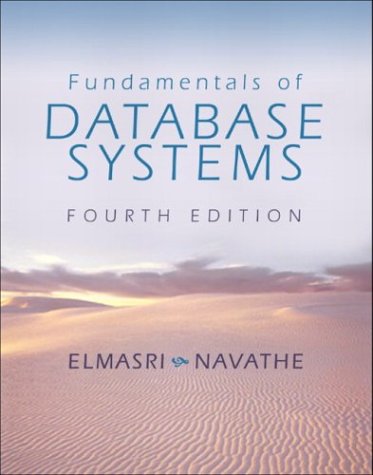
Fundamentals of Database Systems (4th Edition)

Authors: Elmasri , Navathe 
Pages:  1009
Publisher: Addison Wesley;
Edition : Forth
Date Released: (July 23, 2003) 
Languague: English
ISBN: 0321122267
Format: PDF 
Size: 38 MB


Description:

 Fundamentals of Database Systems has become the world-wide leading textbook because it combines clear explanations of theory and design, broad coverage of models and real systems, and excellent examples with up-to-date introductions and modern database technologies. This book has been revised and updated to reflect the latest trends in technological and application development. This fourth edition expands on many of the most popular database topics, including SQL, security, and data mining along with an introduction to UML modeling and an entirely new chapter on XML and Internet databases.

Table Of Contents:

I. INTRODUCTION AND CONCEPTUAL MODELING.
1. Databases and Database Users. 
2. Database System Concepts and Architecture. 
3. Data Modeling Using the Entity-Relationship Model. 
4. Enhanced Entity-Relationship and UML Modeling. 


II. RELATIONAL MODEL: CONCEPTS, CONSTRAINTS, LANGUAGES, DESIGN, AND PROGRAMMING.
 5. The Relational Data Model and Relational Database Constraints. 
 6. Relational Algebra and Relational Calculus. 
7. Relational Database Design by ER- and EER-to-Relational Mapping. 
8. SQL99-Schema Definition, Constraints, and Queries. 
9. More SQL-Assertions, Views, and Programming Techniques. 


III. DATABASE DESIGN THEORY AND METHODOLOGY.
10. Functional Dependencies and Normalization for Relational Databases. 
11. Relational Database Design Algorithms and Further Dependencies. 
12. Practical Database Design Methodology Using UML. 

IV. DATA STORAGE, INDEXING, QUERY PROCESSING, AND PHYSICAL DESIGN.
13. Disk Organization, Basic File Structures, and Hashing. 
14. Indexing Structures for Files. 
15. Algorithms for Query Processing and Optimization. 
16. Physical Database Design and Tuning. 

V. TRANSACTION PROCESSING CONCEPTS.
17. Introduction to Transaction Processing Concepts and Theory. 
18. Concurrency Control Techniques. 
19. Database Recovery Techniques. 

VI. OBJECT AND OBJECT-RELATIONAL DATABASES.
20. Object Database Concepts. 
21. The ODMG Standard for Object Databases. 
22. Object-Relational Systems and SQL3. 

VII. FURTHER TOPICS.
23. Database Security, Authorization, and Encryption. 
24. Enhanced Data Models for Advanced Applications. 
25. Distributed Databases and Client-Server Architectures.

VIII. EMERGING TECHNOLOGIES.
26. Internet Databases and XML.  
27. Data Warehousing and Data Mining Concepts. 
28. Emerging Database Technologies and Applications. 
Appendix A. Alternative Diagrammatic Notations for ER models. 
Appendix B. Database Design and Application Implementation Case Study. 
(New appendix on the Web including a detailed database design case study). 
Appendix C. Parameters of Disks (old Appendix B). 
Appendix D. The QBE Language (old section 9.5). 
Appendix E. Hierarchical Data Model (old Appendix C dropped - moved to Web). 
Appendix F. Network Data Model (old Appendix D dropped - moved to Web). 
Bibliographic References. 
Index. 


DOWNLOAD BOOK HERE

Fundamentals of Fluid Mechanics, 5th Edition


Bruce R. Munson, Donald F. Young, Theodore H. Okiishi  
ISBN: 978-0-471-67582-2
Hardcover
816 pages
July 2005


About The Book

Master fluid mechanics with the #1 text in the field!

Effective pedagogy, everyday examples, an outstanding collection of practical problems--these are just a few reasons why Munson, Young, and Okiishi's Fundamentals of Fluid Mechanics is the best-selling fluid mechanics text on the market. In each new edition, the authors have refined their primary goal of helping you develop the skills and confidence you need to master the art of solving fluid mechanics problems.

This new Fifth Edition includes many new problems, revised and updated examples, new Fluids in the News case study examples, new introductory material about computational fluid dynamics (CFD), and the availability of FlowLab for solving simple CFD problems.

Access special resources online

New copies of this text include access to resources on the book's website, including:
* 80 short Fluids Mechanics Phenomena videos, which illustrate various aspects of real-world fluid mechanics.
* Review Problems for additional practice, with answers so you can check your work.
* 30 extended laboratory problems that involve actual experimental data for simple experiments. The data for these problems is provided in Excel format.
* Computational Fluid Dynamics problems to be solved with FlowLab software.

Student Solution Manual and Study Guide

A Student Solution Manual and Study Guide is available for purchase, including essential points of the text, "Cautions" to alert you to common mistakes, 109 additional example problems with solutions, and complete solutions for the Review Problems.
 

TABLE OF CONTENTS

1. Introduction.
2. Fluid Statics.
3. Elementary Fluid Dynamics -- The Bernoulli Equation.
4. Fluid Kinematics.
5. Finite Control Volume Analysis.
6. Differential Analysis of Fluid Flow.
7. Similitude, Dimensional Analysis, and Modeling.
8. Viscous Flow in Pipes.
9. Flow Over Immersed Bodies.
10. Open-Channel Flow.
11. Compressible Flow.
12. Turbomachines.
Appendix A: Computational Fluid Dymanics and FlowLab.
Appendix B: Physical Properties of Fluids.
Appendix C: Properties of the U.S. Standard Atmosphere.
Appendix D: Compressible Flow Data for an Ideal Gas.
Appendix E: Comprehensive Table of Conversion Factors (e-Book).
Appendix F: Video Library (e-Book).
Appendix G: Review Problems (e-Book).
Appendix H: Laboratory Problems (e-Book).
Appendix I: CFD Driven Cavity Example (e-Book).
Appendix J: Flowlab Tutorial and User's Guide.
Appendix K: Flowlab Problems.
Answers.
Index.


DOWNLOAD BOOK                                   HERE 
DOWNLOAD SOLUTION                          HERE 

Fluid Mechanics: Fundamentals and Applications by Yunus A. Cengel, John M. Cimbala

Author: Yunus A. Cengel, John M. Cimbala 
ISBN-10: 0072472367
ISBN-13: 9780072472363
Publisher: McGraw-Hill College
864 pages
McGraw-Hill Series in Mechanical Engineering
Language: English


TABLE OF CONTENTS

C H A P T E R    O N E
INTRODUCTION AND BASIC CONCEPTS 
C H A P T E R    T W O
PROPERTIES OF FLUIDS 
C H A P T E R    T H R E E
PRESSURE AND FLUID STATICS 
C H A P T E R    F O U R
FLUID KINEMATICS 
C H A P T E R    F I V E
MASS, BERNOULLI, AND ENERGY EQUATIONS 
C H A P T E R    S I X
MOMENTUM ANALYSIS OF FLOW SYSTEMS 
C H A P T E R    S E V E N
DIMENSIONAL ANALYSIS AND MODELING 
C H A P T E R    E I G H T
FLOW IN PIPES 
C H A P T E R     N I N E
DIFFERENTIAL ANALYSIS OF FLUID FLOW 
C H A P T E R     T E N
APPROXIMATE SOLUTIONS OF THE NAIVER–STOKES EQUATION 
C H A P T E R     E L E V E N
FLOW OVER BODIES: DRAG AND LIFT 
C H A P T E R     T W E LV E
COMPRESSIBLE FLOW 
C H A P T E R     T H I R T E E N
OPEN-CHANNEL FLOW 
C H A P T E R     F O U R T E E N
TURBO-MACHINERY 
C H A P T E R     F I F T E E N
INTRODUCTION TO COMPUTATIONAL FLUID DYNAMICS
 
DOWNLOAD BOOK                         Ch 1-4 HERE
DOWNLOAD SOLUTION HERE      HERE 

Thermodynamics: An Engineering Approach


ISBN: 9780071257718 
Division: Higher Education
Pub Date: JUL-07
Pages: 1016

Edition: 05
Format: Paperback


About the book

The fifth edition of Thermodynamics: An Engineering Approach moves students toward a clear understanding and a firm grasp of the basic principles of thermodynamics. This textbook communicates directly with tomorrow's engineers in a simple yet precise manner that encourages creative thinking and is read by students with interest and enthusiasm. Over 700 new homework problems and a new media packages that includes: ARIS--which offers instructors the ability to assign and grade text-specific homework within the industry's most robust and versatile homework management system. In addition to ARIS, Cengel also offers Hands On Mechanics. This media product provides detailed instructions on to build proven, classroom tested, effective 3-D teaching tools using materials found in any lab or local hardware store


Table Of Contents:

1 Introduction and Basic Concepts
2 Energy Conversion and General Energy Analysis
3 Properties of Pure Substances
4 Energy Analysis of Closed Systems
5 Mass and Energy Analysis of Control Volumes
6 The Second Law of Thermodynamics
7 Entropy
8 Energy: A Measure of Work Potential
9 Gas Power Cycles
10 Vapor and Combined Power Cycles
11 Refrigeration Cycles
12 Thermodynamic Property Relations
13 Gas Mixtures
14 Gas Vapor Mixtures and Air-Conditioning
15 Chemical Reactions
16 Chemical and Phase Equilibrium
17 Compressible Flow
Appendix 1 Property Tables and Charts (SI Units)
Appendix 2 Property Tables and Charts (English Units)


DOWNLOAD BOOK                HERE
DOWNLOAD SOLUTION          HERE

Blog Widget by LinkWithin